
Passover, First Fruits, Pentecost
Passover, First Fruits, Pentecost
Dec 16, 2025
Jewish Feasts: History & Prophecy
For many believers today, the biblical feasts are viewed as “Old Testament holidays,” beautiful but distant, meaningful but not essential. Yet Scripture paints a different picture. These feasts are not relics of ancient Israel—they are prophetic appointments, God’s calendar markers that reveal the mission of Jesus and the unfolding story of redemption (Colossians 2:16–17).
The spring feasts—Passover, First Fruits, and Pentecost—are especially rich in meaning. They are not just historical memorials; they are divine blueprints that pointed to Christ’s first coming and illuminate His ongoing work in the Church.
As Christians we have the opportunity to understand the depth and precision of these feasts and not take them lightly. We could celebrate them—not as law, but as revelation. We could study them—not for ritual, but for relationship. We can appreciate them—not only as Jewish traditions, but as fulfilled and future prophecy.
Let’s explore the incredible prophetic significance behind these foundational feasts.
The Lamb, Deliverance, Cross
Passover is not simply a Jewish “thing” —it is the very foundation of the gospel. The date and meaning is clearly established in the Torah of the Old Testament.
Israel was instructed to choose an unblemished lamb and slaughter it “between the evenings” on the 14th day of Nisan (Exodus 12:5–6), and He declared, “In the fourteenth day of the first month at even is the LORD’s Passover” (Leviticus 23:5). This marking of time is repeated again when Moses commands Israel to keep the Passover “in its appointed season…according to all its rites” on the 14th day (Numbers 9:2–5).
Historically, this feast commemorates the night Israel was delivered from Egypt, when judgment passed over every home marked with the blood of the lamb (Exodus 12:11–14).
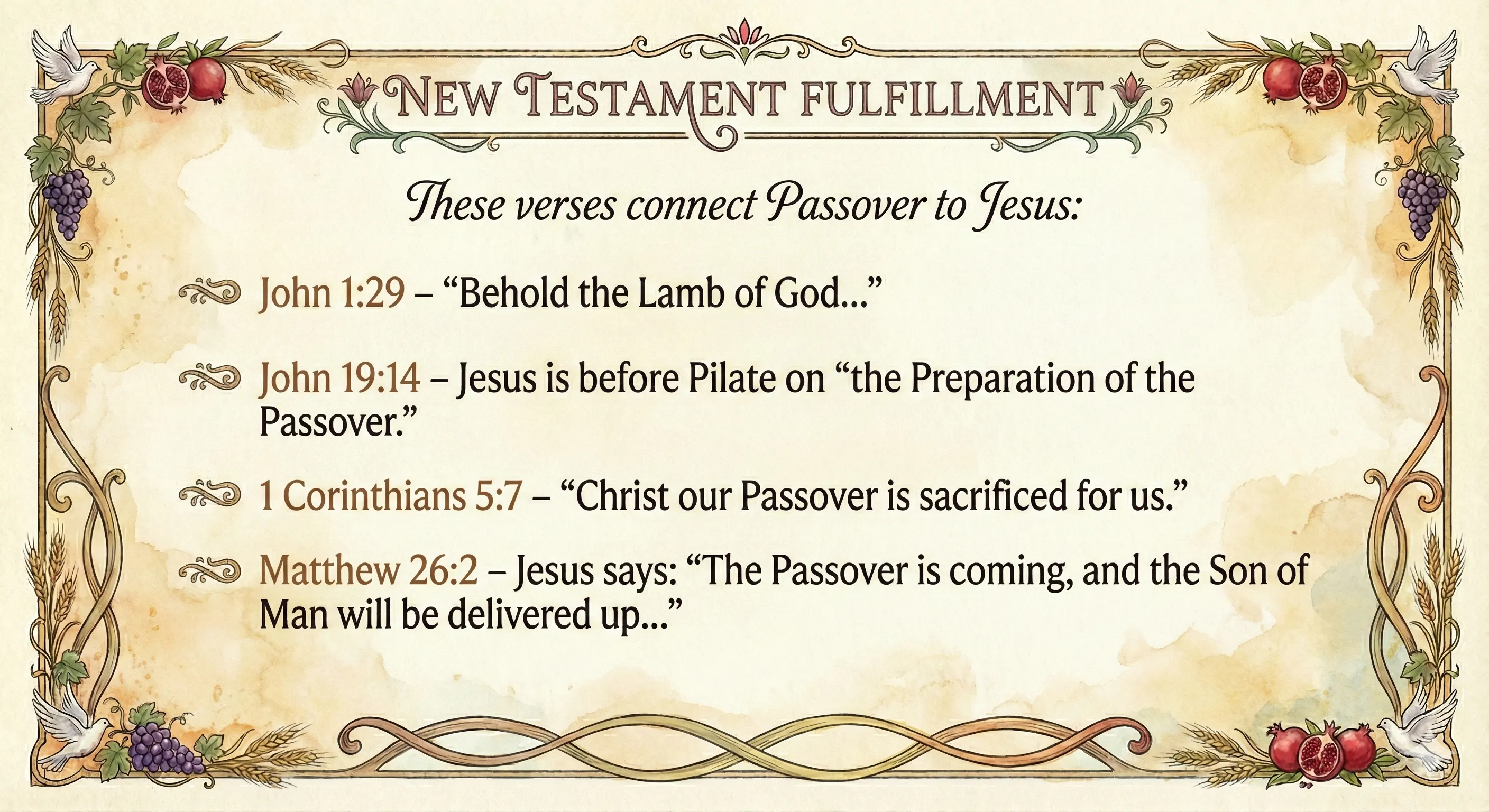
Prophetically, Passover pointed directly and unmistakably to Jesus. John the Baptist identified Him as “the Lamb of God who takes away the sin of the world” (John 1:29). Jesus Himself announced that His crucifixion would occur at Passover (Matthew 26:2). According to John’s Gospel, Jesus stood before Pilate on “the Preparation of the Passover” (John 19:14), the very day the lambs were being readied for slaughter.
Paul then draws the line with definitive clarity:
“Christ, our Passover Lamb, has been sacrificed” (1 Corinthians 5:7).
Passover finds its true and ultimate fulfillment in Christ —the spotless lamb, the blood applied, the deliverance from bondage. For Christians, Passover is not merely a Jewish holiday; it is the prophetic hinge of salvation.
Resurrection Day in Advance
The Feast of First Fruits can seem overlooked, but Scripture gives precise timing for it. Israel is instructed that the offering of the first sheaf of barley must occur “on the day after the Sabbath” during the Feast of Unleavened Bread (Leviticus 23:9–11). This means First Fruits always fell on a Sunday. Israel was forbidden to eat from the new harvest until the first fruits were presented to the Lord (Leviticus 23:14), signifying that the entire harvest belonged to God.
Historically, this offering marked the beginning of the harvest season. But its prophetic purpose pointed to the resurrection of Jesus Christ.
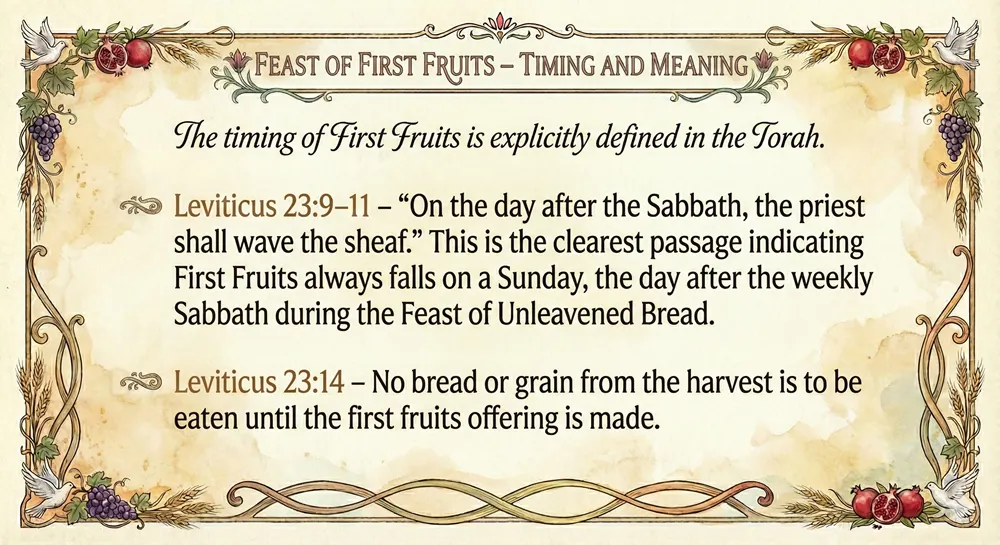
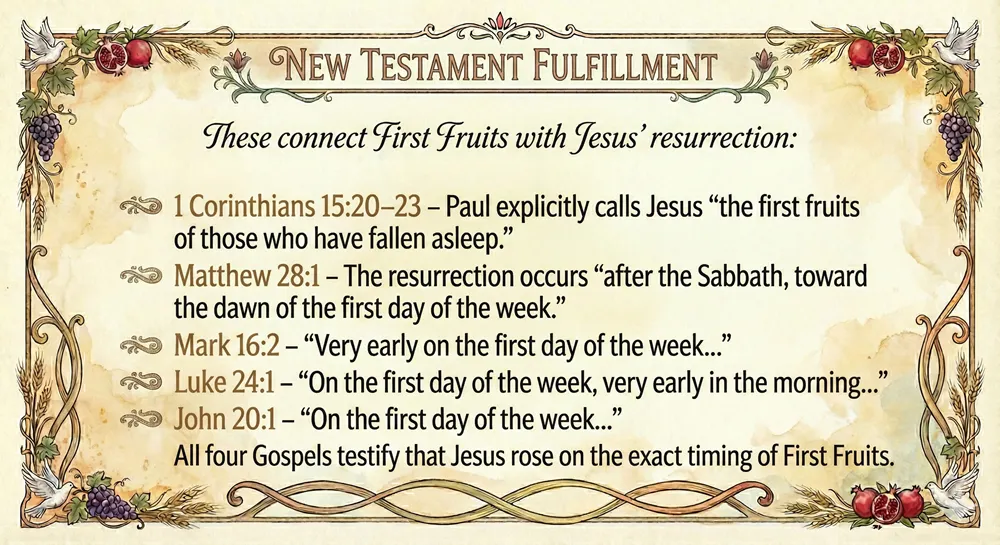
All four Gospels report that Jesus rose “on the first day of the week”—the exact timing of First Fruits (Matthew 28:1; Mark 16:2; Luke 24:1; John 20:1). Paul makes the prophetic connection unmistakable when he writes, “Christ has been raised from the dead, the first fruits of those who have fallen asleep.” (1 Corinthians 15:20–23)
Just as the first sheaf promised a full harvest to come, Jesus’ resurrection points to the future resurrection of believers. His victory is not an isolated miracle—it is the beginning of God’s harvest of redeemed humanity (Revelation 14:4).

First Fruits teaches Christians to see the resurrection not only as a past event but as a prophetic declaration of what God is still doing today.
From Sinai to Upper Room
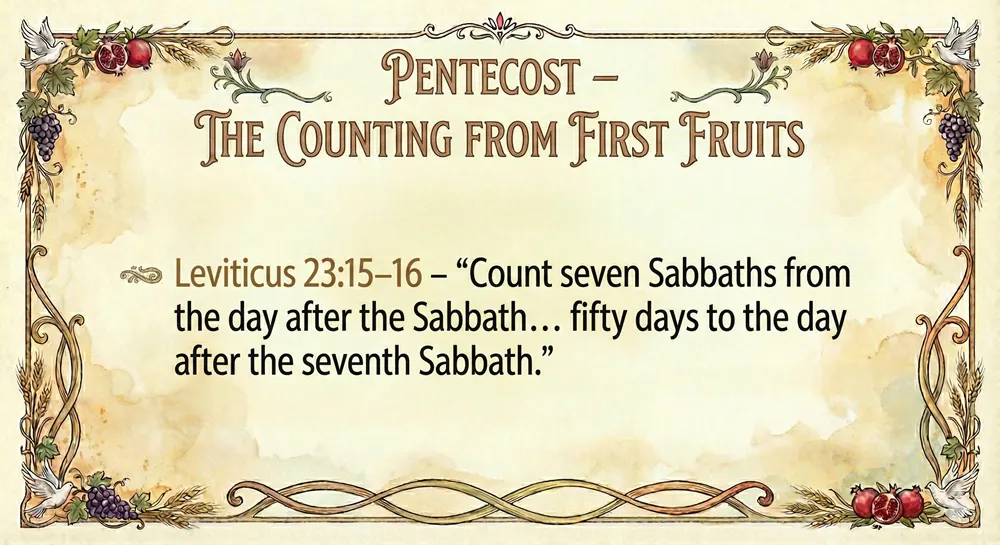
Pentecost, or Shavuot, is also anchored in precise biblical timing. After the Feast of First Fruits, Israel is commanded to count seven Sabbaths, then celebrate the feast “fifty days…on the day after the seventh Sabbath” (Leviticus 23:15–16). This again lands on a Sunday, making Pentecost the second feast permanently attached to the first day of the week.
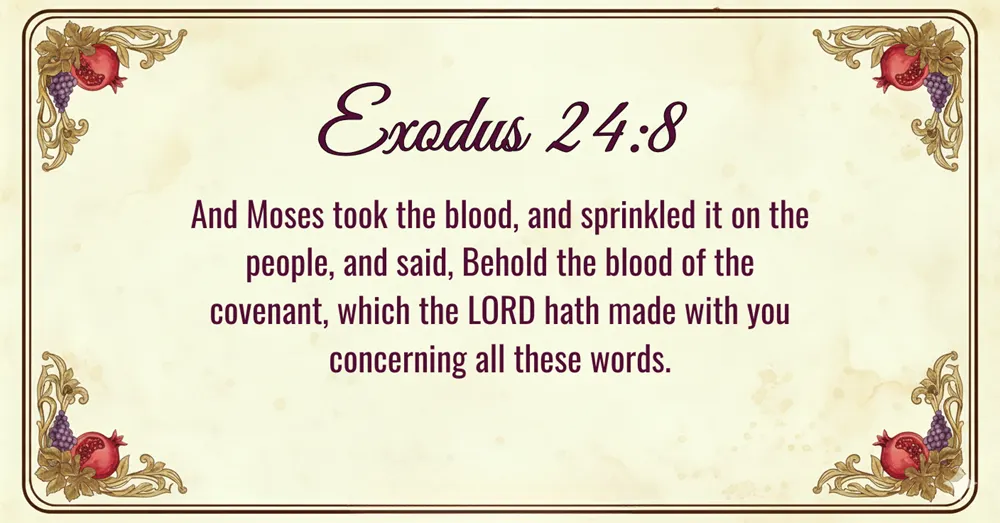
Historically, Pentecost commemorates the giving of the Torah at Mount Sinai. Israel arrived at Sinai “in the third month” (Exodus 19:1), the traditional timing of Shavuot. The third month is the same month Pentecost occurs. What happened after they arrived at Sinai next was nothing short of earth-shaking: God descended in fire, thunder, and thick cloud (Exodus 19:16–19), giving the Ten Commandments (Exodus 20:1–17). Moses read the book of the covenant aloud to the people. It was a dramatic event, and the people said, “All that the Lord hath said we do, and be obedient.” (Exodus 24:3–8).
The Torah does not explicitly say the Law was given on Pentecost, but Jewish tradition (dating back well before Jesus’ time) firmly associates Shavuot with the giving of the Torah. This understanding shapes the prophetic link to Acts 2. Pentecost became the anniversary of the giving of the Torah. “The word “Pentecost” is actually a New Testament term—derived from the Greek word for ‘fiftieth’—whereas the Old Testament refers to the same feast by its Hebrew name, Shavuot or the Feast of Weeks.” This historical event becomes the prophetic mirror of Acts 2.
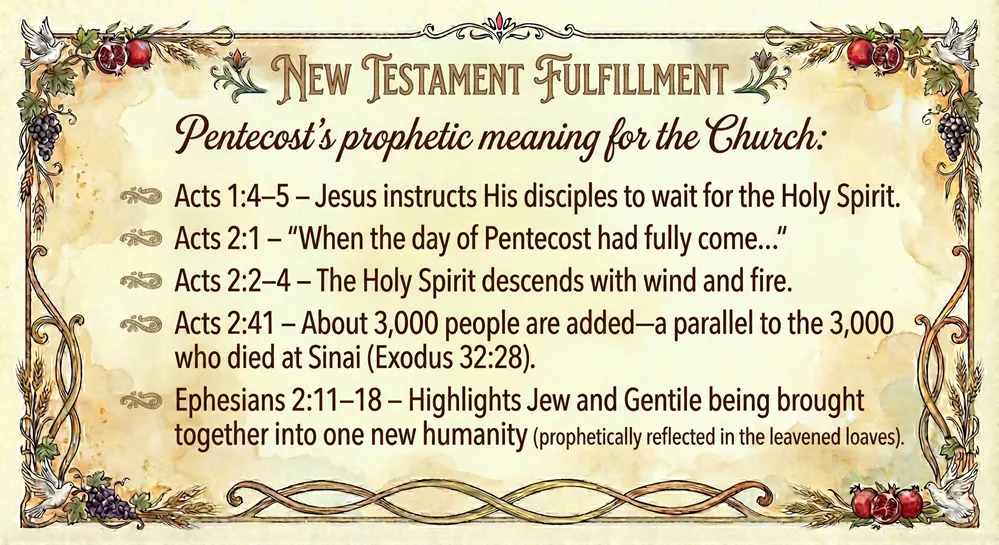
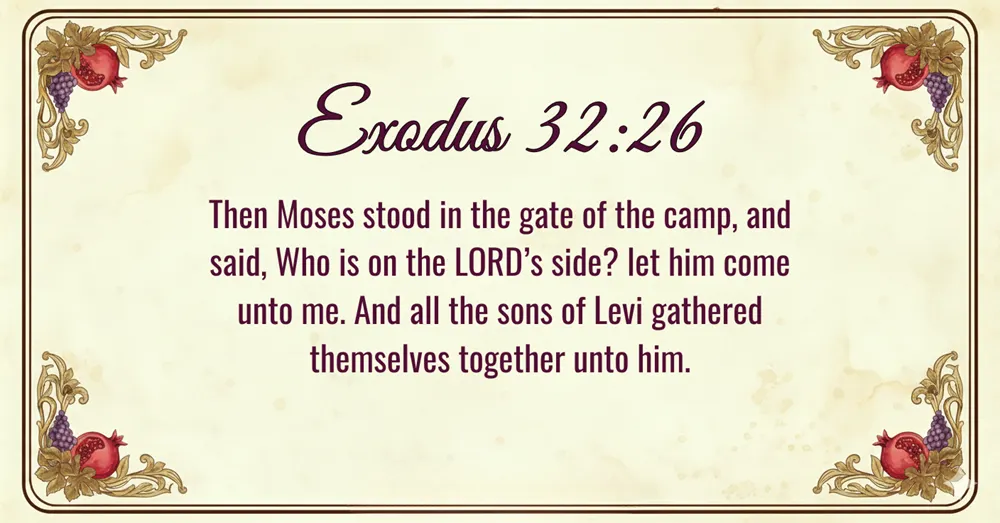
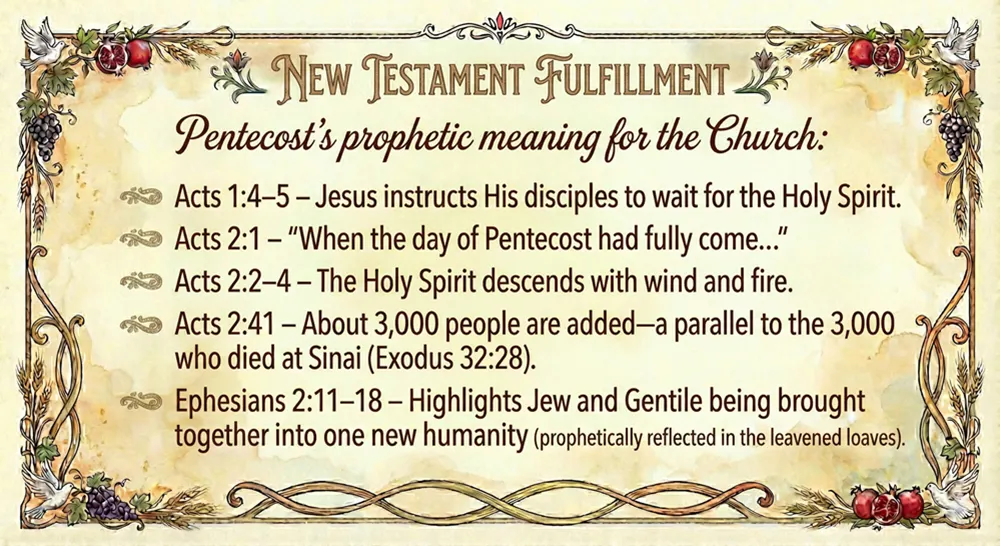
Fifty days after Jesus’ crucifixion at Passover, “when the day of Pentecost had fully come” (Acts 2:1), the Holy Spirit descended upon the disciples with wind and fire (Acts 2:2–4). The parallels between Sinai and Acts 2 are striking: fire, a divine descent, covenant formation, and a new community being established. At Sinai, 3,000 died because of sin (Exodus 32:28); at Pentecost, 3,000 were saved and added to the Church (Acts 2:41).
The reason 3,000 died at Sinai traces back to Israel’s sin with the golden calf. While Moses was receiving the covenant on the mountain, the people turned to idolatry, breaking the very command God had just spoken (Exodus 32). Moses was on the mountain for forty days and forty nights (Exodus 24:18), the people grew impatient in his absence. When Moses confronted the nation, the Levites responded and about 3,000 idolaters were put to death (Exodus 32:28). This moment highlighted the seriousness of covenant rebellion.
Pentecost is also the only feast that uses leavened bread—two loaves lifted before the Lord—which prophetically pictures Jew and Gentile (Ephesians 2:11–18). It was never intended to be a Jewish-only feast; it foreshadowed a multi-national Kingdom empowered by one Spirit.
For Christians, Pentecost is not merely the “birthday of the Church.” It is a prophetic demonstration of God forming a new covenant people, just as He did at Sinai.
Precise Fulfillment
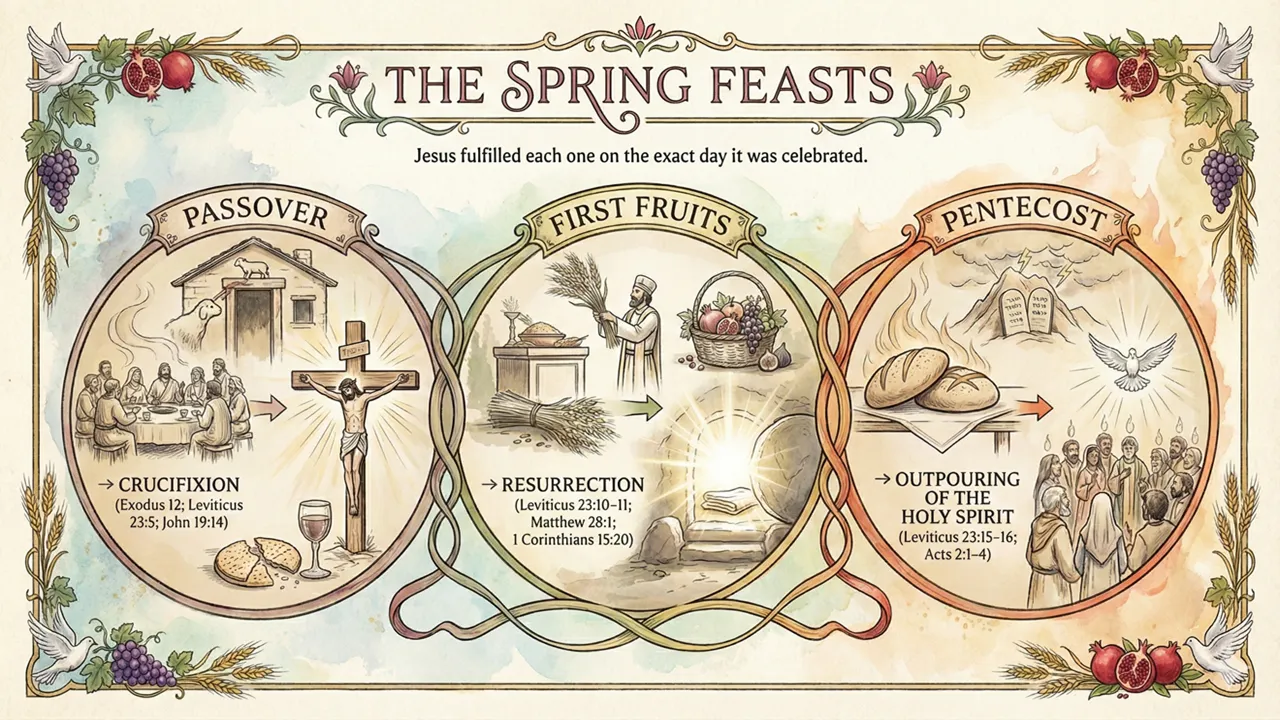
The spring feasts reveal something astonishing:
Jesus fulfilled each one on the exact day it was celebrated.
Passover → Crucifixion
(Exodus 12; Leviticus 23:5; John 19:14)
First Fruits → Resurrection
(Leviticus 23:10–11; Matthew 28:1; 1 Corinthians 15:20)
Pentecost → Outpouring of the Holy Spirit
(Leviticus 23:15–16; Acts 2:1–4)
If the first three feasts were fulfilled with such precision, why should we not expect the remaining feasts to hold similar prophetic patterns connected to Christ’s return.
Understanding these feasts deepens our faith by showing:
God’s Prophetic Calendar Is Precise
The feasts are mo’edim—appointed times—set by God Himself
(Leviticus 23:2).
Jesus Is Revealed More Deeply
The symbols, rituals, and dates shed light on who Jesus is
(1 Peter 1:18–19; Isaiah 53:7).
The Church’s Story Is Rooted in Israel’s Story
We are grafted into a narrative God has been writing since Genesis
(Romans 11:17–18).
The Future Is Already Foreshadowed
The spring feasts foretold His first coming; the fall feasts likely foreshadow His return. The more we understand the feasts, the more clearly we can discern the times.
Remember the Feasts
Christians are not commanded to observe these feasts in the way the Law required—Christ fulfilled the requirements. But we are wise to study them, honor them, reflect on them, and allow them to powerfully support our faith and shape our understanding of purpose and prophecy.
The feasts are a fascinating part of God’s plan to redeem us to Himself.
To know the feasts is to know Jesus more fully.
To study the feasts is to see prophecy unfold.
To remember the feasts is to see more clearly how God reveals His character and purpose through the Scripture.
These sacred appointments can be recognized —not merely as rituals, but as prophecy.
~Lorrinda @sisteradmn